 Skip to content


Can unreplicated (UR) trials provide the accuracy we need? My answer to this question is no. Unreplicated trials lack the accuracy we need to select the outstanding genotypes, but this does not mean they are not useful! I will expand on this and set out some pros/cons associated with these trials that we need to be aware of.
UR trials are a statistical heresy!
In statistical training we have been taught about the importance of replication for statistical inference. No replication (or limited replication) translates into poor estimation of the background error, a lack of degrees of freedom, and limited statistical power to detect differences.
In a UR trial the replication only occurs on the control (i.e., check) genotypes, providing us with at least some information on variability. But for our test genotypes, we do not have any replication! Hence, why do we conduct UR trials? Well, the main argument is about limited resources. First, we might only have a few seeds or plants available to evaluate in a trial; and second, we probably want to reduce testing costs. However, the choice to perform a UR trial has important statistical drawbacks (see Part 1) but I believe we justify this choice on the fact that our focus is on ranking in order to select ‘potential’ genotypes, and not on formal statistical inference per se.
UR trials are good for eliminating genotypes but not for identifying the best genotypes
Considering the issue of no (or limited) replication, it is very clear that the actual test genotype effects have been estimated poorly. We expect large standard errors and because they are in a single physical spot, they are most likely biased by environmental noise that is hard to separate from the genetic signal. This will translate into a low correlation between their true and estimated genetic values.
However, this does not mean UR trials are not useful. Think about a correlation of 0.3 between the true and estimated genetic values (see example below). We can’t identify the best genotypes with much certainty, but, for example, if we have, say 800 genotypes, and we select the top 10% of them (i.e., 80) as candidates, even with this poor correlation, we are very likely to have the majority of the BEST genotypes (for example 4 out of 5) included in this set. Nevertheless, in order to really identify them from the 80 candidates, this reduced set needs to be tested in replicated trials.
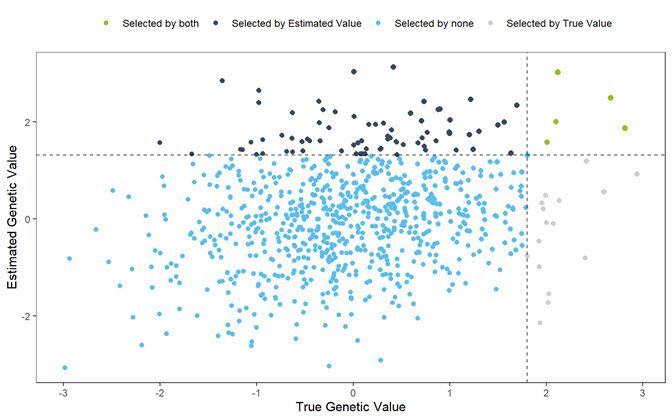
Risks in extending UR trials to late-generation experiments
Above I mentioned the poor correlation between estimated and true genetic effects. The use of UR trials in any late-generation trials will have the same issues. Therefore, I consider that UR trials should NEVER be used in anything other than early-generation trials. After all, with UR trials you will ALWAYS need to re-evaluate the selected candidate genotypes to identify the BEST ones, and you do not want to have to verify this by the time you reach the farmer trials.
Challenges in Genomic Prediction models with UR trials
We tend to forget, but the critical part for genomic prediction (GP) models is the phenotypic information rather than the genotypic information. If there is too much noise in the response variable, something that happens in UR trials as we have limited information to separate the genetic signal from the noise, then the model will be of poor quality. Even if the GP model appears reasonable, it is likely that it is ‘accommodating’ to the poor or incorrect response variable provided.
I believe using UR trials in GP models is risky business; it seems strange that given the monetary expense required to genotype a reasonable number of markers, we then decide to have a poor phenotypic record based on single replication to use to fit these predictive models!
Optimizing UR trials within multi-environmental settings
This aspect will be a bit different in an MET with UR trials where the focus is not on the estimation of the GxE but on the main effect of genotype across all environments (see Part 1). This is probably where UR trials are the most useful, as the number of sites evaluated is maximized given the resource restrictions (in particular, germplasm). In addition, the incorporation of a genomic relationship matrix enables ‘connections’ between genotypes across sites even when there is some level of unbalance (or planned sparse testing). In this case, we can expect very reasonable results; nevertheless, at the single-site level with UR trials these models will still be highly inaccurate.
The sophisticated dynamics of UR trials
These trials will have the best statistical properties whenever there is high heritability (low background noise), good spatial correlations (additional replication), and good estimation of the background noise (reasonable replication of the check lines). If the focus of UR trials is a single site, then these trials are no more than a sophisticated mass selection procedure. If you have no spatial components and no genetic relationships, then your ranking will be exactly the same as you see in your observed phenotypic response. And what is the difference of this with respect to walking on the field and performing a mass selection? I see none.
Hence, a realistic lower bound for the usefulness of UR trials is that they are no better than mass selection, and for this reason as a breeder we need to ask ourselves if for, say those 800 genotypes tested, we are happy enough to select them without any statistical analyses: just by walking in the field. If the answer is no, then you need to make sure you have some replication.
Final remarks
There is a good quantity of publications and research associated with UR trials, with empirical work and simulations. Some of the above statements have been verified with my own simulations and empirical work evaluating this type of data. However, I do understand that the characteristics of a given breeding program will affect the usefulness of these trials. Important elements to keep in mind when you assess their usefulness are: level of genetic control (heritability), levels of spatial correlation, level of GxEs, number of genotypes selected for later stages, quality of the genomic and/or pedigree information, etc. All of these elements will push the balance one way or another, but I still think UR trials are useful but dangerous.


